Clinical Stimulation Software
Core team, CORTIVIS Trial (NCT02983370)
Built the complete neurostimulation and recording stack for a Utah array visual prosthesis trial. Designed psychophysics experiments, calibrated ICMS parameters, and developed real-time stimulation control through Blackrock hardware.
Python
Blackrock Neurotech
Psychophysics
Neurolight
Real-time DL neural interface
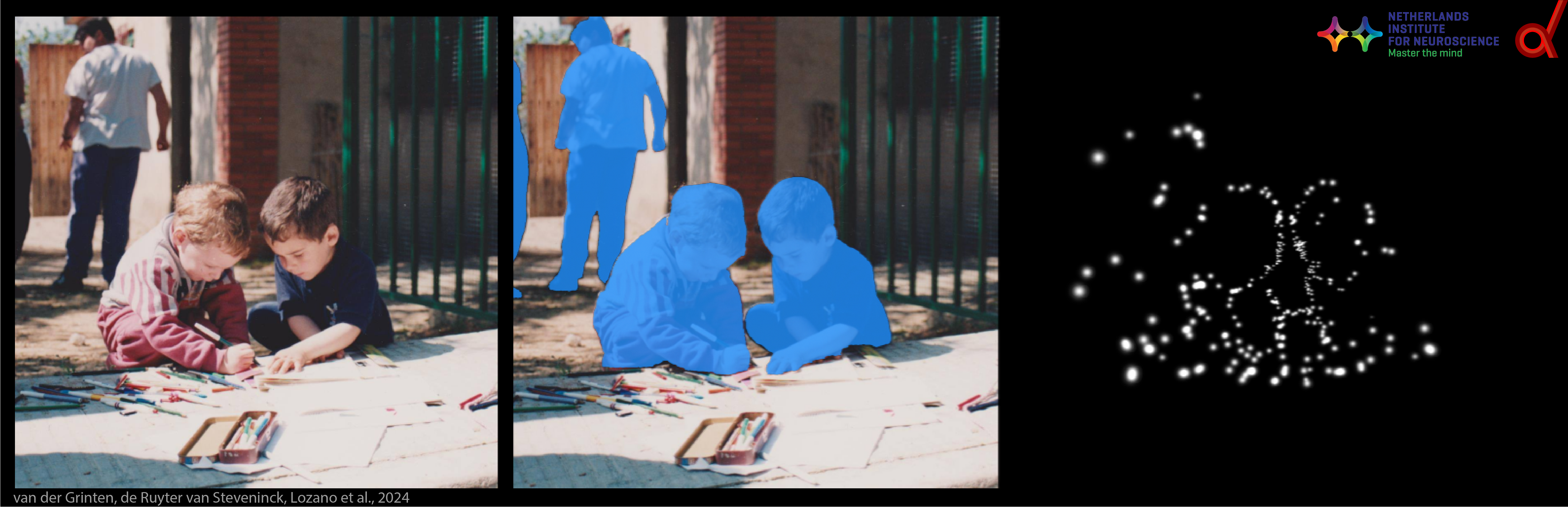
End-to-end system connecting computer vision models to cortical microstimulation. Runs object detection and segmentation on edge hardware (Jetson, Intel NCS) with gaze tracking, driving amplitude/frequency-modulated stimulation at 20+ FPS.
Tensorflow / Keras
TensorRT / ONNX
Edge Computing
Dynaphos
Differentiable phosphene simulator
PyTorch-based phosphene simulation with cortical magnification, temporal dynamics, and user-specific maps. Enables end-to-end optimization of stimulation encoding. Runs at 100+ FPS on consumer GPUs.
PyTorch
Differentiable
Open Source
NEUmap
Large-scale electrode mapping
Semi-automatic method to infer phosphene maps from seconds of resting-state neural data. Validated on 300-700 NHP electrodes and 73-91 human electrodes with correlations up to 0.93.
Dimensionality Reduction
LFP/MUA
Brain Stimulation
vimplant
Implant placement optimization
Bayesian optimization pipeline for electrode array placement using fMRI retinotopy. Validated on 362 brain hemispheres with safety-aware constraints for blood vessel avoidance.
Bayesian Opt
fMRI
Open Source
1024-ch NHP Experiments
Vision & Cognition Lab, NIN Amsterdam
Large-scale electrophysiology with 16 Utah arrays across V1, V4, IT. Designed experiments for RF mapping, microstimulation propagation, and closed-loop neural recordings. Analyzed TB-scale datasets.
Electrophysiology
Microstimulation
NHP